Rhynchophorus ferrugineus
red palm weevil, Asian palm weevil or sago palm weevil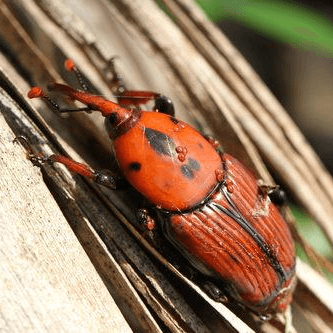
Rhynchophorus ferrugineus is one of two species of snout beetle. The adult beetles are relatively large, ranging between 2 and 4 centimetres (1 and 1 1⁄2 inches) long, and are usually a rusty red colour—but many colour variants exist and have often been classified as different species (e.g., Rhynchophorus vulneratus). Weevil larvae can excavate holes in the trunks of palm trees up to 1 metre (3.3 ft) long, thereby weakening and eventually killing the host plant. As a result, the weevil is considered a major pest in palm plantations, including the coconut palm, date palm and oil palm.
Host Genome
Scaffold| Genome ID | Level | BUSCO Assessment |
|---|---|---|
| GCA_014462685.1 | Scaffold |
C:94.5%[S:92.2%,D:2.3%],F:1.2%,M:4.3%,n:1367
|
Download Genome Files
Related Symbionts
19 recordsSymbiont records associated with Rhynchophorus ferrugineus
| Classification | Function | Function Tags | Reference | |
|---|---|---|---|---|
|
Nardonella
Pseudomonadota |
Bacteria
|
Candidatus Nardonella is an endosymbiont that participates in tyrosine production for its host, Rhynchophorus ferrugineus, potentially involving the … |
amino acid provision
|
|
|
Enterobacter cloacae
Pseudomonadota |
Bacteria
|
Enterobacter cloacae promotes the development and body mass gain of Rhynchophorus ferrugineus (RPW) larvae by improving their nutrition metabolism. |
nutrient provision
growth regulation
|
|
|
Lactococcus lactis
Bacillota |
Bacteria
|
Lactococcus lactis promotes the development and body mass gain of Rhynchophorus ferrugineus (RPW) larvae by improving their nutrition metabolism. |
nutrient provision
growth regulation
|
|
|
Bacteria
|
Intestinal Microbiota confer protection by priming the immune system of the host Rhynchophorus ferrugineus against pathogenic bacteria. |
immune priming
|
||
|
Enterobacter
Pseudomonadota |
Bacteria
|
Enterobacter can degrade plant polysaccharides and confer host optimal adaptation to its environment by modulating its metabolism. |
carbohydrate metabolism
|
|
|
Citrobacter
Pseudomonadota |
Bacteria
|
Citrobacter can degrade plant polysaccharides and confer host optimal adaptation to its environment by modulating its metabolism. |
carbohydrate metabolism
|
|
|
Klebsiella
Pseudomonadota |
Bacteria
|
Klebsiella can degrade plant polysaccharides and confer host optimal adaptation to its environment by modulating its metabolism. |
carbohydrate metabolism
|
|
|
Serratia
Pseudomonadota |
Bacteria
|
Serratia can degrade plant polysaccharides and confer optimal host adaptation to its environment by modulating its metabolism. |
carbohydrate metabolism
|
|
|
Bacteria
|
Intestinal Microbiota confer protection by priming the immune system of the host Rhynchophorus ferrugineus. |
immune priming
|
||
|
Enterobacter
Pseudomonadota |
Bacteria
|
Enterobacter exhibits anti-phytopathogenic fungi activity, and promotes host growth and development. |
antimicrobial activity
|
|
|
Candidatus Nardonella
Pseudomonadota |
Bacteria
|
Candidatus Nardonella is involved in tyrosine precursor provisioning. |
amino acid provision
|
|
|
bacteria
- |
Bacteria
|
- |
||
|
Enterobacteriaceae
Pseudomonadota |
Bacteria
|
- |
||
|
Entomoplasmataceae
Mycoplasmatota |
Bacteria
|
- |
||
|
Bacteria
|
- |
|||
|
Bacteria
|
- |
|||
|
Lactobacillaceae
Bacillota |
Bacteria
|
- |
||
|
Nardonella
Pseudomonadota |
Bacteria
|
- |
||
|
Streptococcaceae
Bacillota |
Bacteria
|
- |
Metagenome Information
0 recordsMetagenome sequencing data associated with Rhynchophorus ferrugineus
| Run | Platform | Location | Date | BioProject |
|---|---|---|---|---|
No metagenomes foundNo metagenome records associated with this host species. |
||||
Amplicon Information
0 recordsAmplicon sequencing data associated with Rhynchophorus ferrugineus
| Run | Classification | Platform | Location | Environment |
|---|---|---|---|---|
No amplicons foundNo amplicon records associated with this host species. |
||||
Related Articles
6 recordsResearch articles related to Rhynchophorus ferrugineus
| Title | Authors | Journal | Year | DOI |
|---|---|---|---|---|
|
Huang, Y; Feng, ZF; Li, F; Hou, YM
|
Insects
|
2024
|
10.3390/insects15010035 | |
|
Muhammad, A; Habineza, P; Ji, TL; Hou, YM; Shi, ZH
|
FRONTIERS IN PHYSIOLOGY
|
2019
|
10.3389/fphys.2019.01303 | |
|
Habineza, P; Muhammad, A; Ji, TL ... Hou, YM; Shi, ZH
|
FRONTIERS IN MICROBIOLOGY
|
2019
|
10.3389/fmicb.2019.01212 | |
|
Muhammad, A; Fang, Y; Hou, YM; Shi, ZH
|
FRONTIERS IN MICROBIOLOGY
|
2017
|
10.3389/fmicb.2017.02291 | |
|
Montagna, M; Chouaia, B; Mazza, G ... Bandi, C; Daffonchio, D
|
PLOS ONE
|
2015
|
10.1371/journal.pone.0117439 | |
|
Tagliavia, M; Messina, E; Manachini, B; Cappello, S; Quatrini, P
|
BMC MICROBIOLOGY
|
2014
|
10.1186/1471-2180-14-136 |