Plutella xylostella
diamondback moth or cabbage moth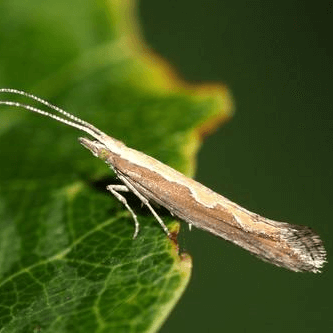
Plutella xylostella is a moth species of the family Plutellidae and genus Plutella. The small, grayish-brown moth sometimes has a cream-colored band that forms a diamond along its back. The species may have originated in Europe, South Africa, or the Mediterranean region, but it has now spread worldwide.
Host Genome
Scaffold| Genome ID | Level | BUSCO Assessment |
|---|---|---|
| GCA_905116875.1 | Scaffold |
C:94.9%[S:94.4%,D:0.5%],F:1.8%,M:3.3%,n:1367
|
Download Genome Files
Related Symbionts
39 recordsSymbiont records associated with Plutella xylostella
| Classification | Function | Function Tags | Reference | |
|---|---|---|---|---|
|
Carnobacterium maltaromaticum
Bacillota |
Bacteria
|
Carnobacterium maltaromaticum plays an important role in the breakdown of plant cell walls, detoxification of plant phenolics, and synthesis of amino… |
amino acid provision
plant biomass digestion
detoxification enzymes
|
|
|
Enterobacter asburiae
Pseudomonadota |
Bacteria
|
Enterobacter asburiae plays an important role in the breakdown of plant cell walls, detoxification of plant phenolics, and synthesis of amino acids. |
amino acid provision
plant biomass digestion
detoxification enzymes
|
|
|
Enterobacter cloacae
Pseudomonadota |
Bacteria
|
Enterobacter cloacae plays an important role in the breakdown of plant cell walls, detoxification of plant phenolics, and synthesis of amino acids. |
amino acid provision
plant biomass digestion
detoxification enzymes
|
|
|
Pantoea agglonierans
Pseudomonadota |
Bacteria
|
Pantoea agglonierans is involved in the degradation of acephate and uses acephate as a source of carbon and energy for growth. |
pesticide metabolization
nutrient provision
|
|
|
Bacillus cereus
Bacillota |
Bacteria
|
Bacillus cereus is involved in the degradation of acephate and uses acephate as a source of carbon and energy for growth. |
pesticide metabolization
nutrient provision
|
|
|
Pantoea sp.
Pseudomonadota |
Bacteria
|
Pantoea sp. showed active decarboxylase activities and poor deaminase activities in the presence of various amino acids. |
protein degradation
|
|
|
Enterobacter
Pseudomonadota |
Bacteria
|
Enterobacter is involved in the degradation of acephate and uses acephate as a source of carbon and energy for growth. |
pesticide metabolization
nutrient provision
|
|
|
Carnobacterium maltaromaticum
Bacillota |
Bacteria
|
Carnobacterium maltaromaticum participates in the synthesis of host-lacking amino acids, histidine and threonine. |
amino acid provision
|
|
|
Bacillus cereus
Bacillota |
Bacteria
|
Bacillus cereus is involved in the degradation of indoxacarb and could use indoxacarb for metabolism and growth. |
pesticide metabolization
nutrient provision
|
|
|
Enterobacter asburiae
Pseudomonadota |
Bacteria
|
Enterobacter asburiae participates in the synthesis of host-lacking amino acids, histidine and threonine. |
amino acid provision
|
|
|
Enterobacter cloacae
Pseudomonadota |
Bacteria
|
Enterobacter cloacae participates in the synthesis of host-lacking amino acids, histidine and threonine. |
amino acid provision
|
|
|
Enterobacter sp.
Pseudomonadota |
Bacteria
|
Enterobacter sp. exhibits activity for cellulose and hemicellulose, and degrades CMC, xylan, and pectin. |
cellulose hydrolysis
xylan hydrolysis
pectin hydrolysis
|
|
|
Enterobacter cloacae JJBC 11.1B StrepR
Pseudomonadota |
Bacteria
|
Enterobacter cloacae JJBC 11.1B StrepR may improve the fitness of transgenic male Plutella xylostella. |
stress resistance
|
|
|
Enterococcus sp.
Bacillota |
Bacteria
|
Enterococcus sp. enhanced resistance to the widely used insecticide, chlorpyrifos, in P. xylostella. |
pesticide metabolization
|
|
|
Serratia sp.
Pseudomonadota |
Bacteria
|
Serratia sp. decreased resistance to the widely used insecticide, chlorpyrifos, in P. xylostella. |
pesticide metabolization
|
|
|
Enterococcus
Bacillota |
Bacteria
|
Enterococcus enhanced resistance to the widely used insecticide, chlorpyrifos, in P. xylostella. |
pesticide metabolization
|
|
|
Carnobacterium maltaromaticum
Bacillota |
Bacteria
|
Carnobacterium maltaromaticum exhibits activity for cellulose and hemicellulose degradation. |
cellulose hydrolysis
|
|
|
Enterobacter cloacae
Pseudomonadota |
Bacteria
|
Enterobacter cloacae increases the pupal weight and male fitness of Plutella xylostella. |
growth regulation
|
|
|
Serratia sp.
Pseudomonadota |
Bacteria
|
Serratia sp. exhibits chitinase activity, which enhances larval growth and development. |
chitin degradation
|
|
|
Serratia marcescens
Pseudomonadota |
Bacteria
|
Serratia marcescens produces chitinase, contributing to host nutrition. |
chitin degradation
|
|
|
Enterobacter asburiae
Pseudomonadota |
Bacteria
|
Enterobacter asburiae degrades the plant phenolic catechol. |
detoxification enzymes
|
|
|
Enterobacter cloacae
Pseudomonadota |
Bacteria
|
Enterobacter cloacae degrades the plant phenolic catechol. |
detoxification enzymes
|
|
|
Pseudomonas
Pseudomonadota |
Bacteria
|
Pseudomonas provides resistance to pathogenic fungi. |
antimicrobial activity
|
|
|
Acinetobacter soli
Pseudomonadota |
Bacteria
|
- |
||
|
Bacillus wiedmannii
Bacillota |
Bacteria
|
- |
||
|
Carnobacterium maltaromaticum
Bacillota |
Bacteria
|
- |
||
|
Carnobacterium maltaromaticum
Bacillota |
Bacteria
|
- |
||
|
Cedecea lapagei
Pseudomonadota |
Bacteria
|
- |
||
|
Cedecea lapagei
Pseudomonadota |
Bacteria
|
- |
||
|
Citrobacter freundii
Pseudomonadota |
Bacteria
|
- |
||
|
Enterobacter ludwigii
Pseudomonadota |
Bacteria
|
- |
||
|
Enterococcus termitis
Bacillota |
Bacteria
|
- |
||
|
Enterococcus termitis
Bacillota |
Bacteria
|
- |
||
|
Bacteria
|
- |
|||
|
Klebsiella pneumoniae
Pseudomonadota |
Bacteria
|
- |
||
|
Klebsiella variicola
Pseudomonadota |
Bacteria
|
- |
||
|
Neisseria perflava
Pseudomonadota |
Bacteria
|
- |
||
|
Staphylococcus warneri
Bacillota |
Bacteria
|
- |
||
|
Stenotrophomonas maltophilia
Pseudomonadota |
Bacteria
|
- |
Metagenome Information
0 recordsMetagenome sequencing data associated with Plutella xylostella
| Run | Platform | Location | Date | BioProject |
|---|---|---|---|---|
No metagenomes foundNo metagenome records associated with this host species. |
||||
Amplicon Information
0 recordsAmplicon sequencing data associated with Plutella xylostella
| Run | Classification | Platform | Location | Environment |
|---|---|---|---|---|
No amplicons foundNo amplicon records associated with this host species. |
||||
Related Articles
7 recordsResearch articles related to Plutella xylostella
| Title | Authors | Journal | Year | DOI |
|---|---|---|---|---|
|
Zhang, SQ; Huang, JL; Wang, QP; You, MS; Xia, XF
|
Insects
|
2022
|
10.3390/insects13090760 | |
|
Somerville, J; Zhou, LQ; Raymond, B
|
Insects
|
2019
|
10.3390/insects10040089 | |
|
Xia, XF; Sun, BT; Gurr, GM ... Xue, MQ; You, MS
|
FRONTIERS IN MICROBIOLOGY
|
2018
|
10.3389/fmicb.2018.00025 | |
|
Li, WH; Jin, DC; Li, FL; Cheng, Y; Jin, JX
|
SYMBIOSIS
|
2017
|
10.1007/s13199-016-0453-4 | |
|
Xia, XF; Gurr, GM; Vasseur, L ... Lin, HL; You, MS
|
FRONTIERS IN MICROBIOLOGY
|
2017
|
10.3389/fmicb.2017.00663 | |
|
Ramya, Shanivarsanthe Leelesh; Venkatesan, Thiruvengadam; Srinivasa Murthy, Kottilingam; Jalali, Sushil Kumar; Verghese, Abraham
|
Brazilian Journal of Microbiology: [publication of the Brazilian Society for Microbiology]
|
2016
|
10.1016/j.bjm.2016.01.012 | |
|
Indiragandhi, P; Anandham, R; Madhaiyan, M ... Saravanan, VS; Sa, T
|
JOURNAL OF APPLIED MICROBIOLOGY
|
2007
|
10.1111/j.1365-2672.2007.03506.x |