Osmia bicornis
Osmia rufa or red mason bee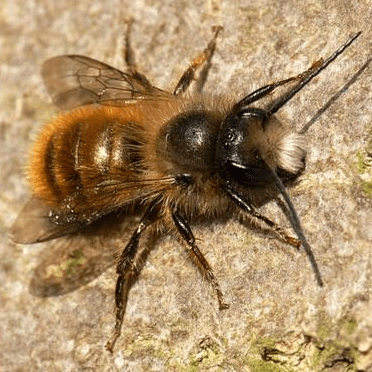
Osmia bicornis is a species of mason bee. It is a solitary bee that nests in holes or stems and is polylectic, meaning it forages pollen from various different flowering plants. These bees can be seen aggregating together and nests in preexisting hollows, choosing not to excavate their own. These bees are not aggressive; they will only sting if handled very roughly and are safe to be closely observed by children. Females only mate once, usually with closely related males. Further, females can determine the sex ratio of their offspring based on their body size, where larger females will invest more in diploid females eggs than small bees. These bees also have trichromatic colour vision and are important pollinators in agriculture.
Host Genome
Chromosome| Genome ID | Level | BUSCO Assessment |
|---|---|---|
| GCA_907164935.1 | Chromosome |
C:98.2%[S:98.0%,D:0.2%],F:0.8%,M:1.0%,n:1367
|
Download Genome Files
Related Symbionts
12 recordsSymbiont records associated with Osmia bicornis
| Classification | Function | Function Tags | Reference | |
|---|---|---|---|---|
|
Bacillus subtillis
Bacillota |
Bacteria
|
Bacillus subtillis inhibits the growth of Ascosphaera spp. and Paenibacillus and may thus have important roles in honey-bee immune defense (pathogen … |
pathogen resistance
|
|
|
Bacillus circulans
Bacillota |
Bacteria
|
Bacillus circulans slows the growth of the honey-bee chalkbrood causative Ascosphaera apis. |
antimicrobial activity
|
|
|
Diaphorobacter
Pseudomonadota |
Bacteria
|
Diaphorobacter may be essential to support Osmia larvae in their nutrient uptake. |
nutrient provision
|
|
|
Burkholderia
Pseudomonadota |
Bacteria
|
Burkholderia may be essential to support Osmia larvae in their nutrient uptake. |
nutrient provision
|
|
|
Variovorax
Pseudomonadota |
Bacteria
|
Variovorax may be essential to support Osmia larvae in their nutrient uptake. |
nutrient provision
|
|
|
Duganella
Pseudomonadota |
Bacteria
|
Duganella may be essential to support Osmia larvae in their nutrient uptake. |
nutrient provision
|
|
|
Massilia
Pseudomonadota |
Bacteria
|
Massilia may be essential to support Osmia larvae in their nutrient uptake. |
nutrient provision
|
|
|
Saccharibacter
Pseudomonadota |
Bacteria
|
Saccharibacter is involved in food uptake and host survival. |
digestive enzymes
|
|
|
Tanticharoenia
Pseudomonadota |
Bacteria
|
Tanticharoenia is involved in food uptake and host survival. |
digestive enzymes
|
|
|
Craurococcus
Pseudomonadota |
Bacteria
|
Craurococcus is involved in food uptake and host survival. |
digestive enzymes
|
|
|
Acidimonas
Pseudomonadota |
Bacteria
|
Acidimonas is involved in food uptake and host survival. |
digestive enzymes
|
|
|
Acidimonas
Pseudomonadota |
Bacteria
|
Acidimonas is involved in food uptake and host survival. |
digestive enzymes
|
Metagenome Information
0 recordsMetagenome sequencing data associated with Osmia bicornis
| Run | Platform | Location | Date | BioProject |
|---|---|---|---|---|
No metagenomes foundNo metagenome records associated with this host species. |
||||
Amplicon Information
0 recordsAmplicon sequencing data associated with Osmia bicornis
| Run | Classification | Platform | Location | Environment |
|---|---|---|---|---|
No amplicons foundNo amplicon records associated with this host species. |
||||
Related Articles
1 recordsResearch articles related to Osmia bicornis
| Title | Authors | Journal | Year | DOI |
|---|---|---|---|---|
|
Alexander Keller, Gudrun Grimmer, Ingolf Steffan-Dewenter
|
PloS One
|
2013
|
10.1371/journal.pone.0078296 |