Aphis fabae
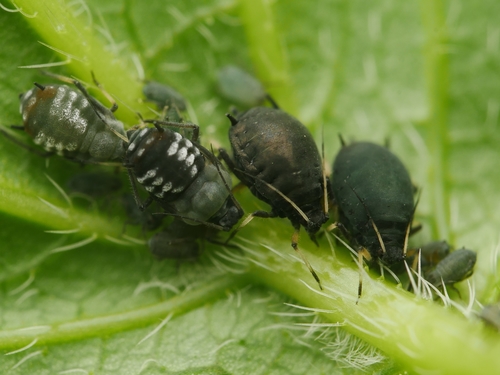
The black bean aphid is a small black insect in the genus Aphis, with a broad, soft body, a member of the order Hemiptera. Other common names include blackfly, bean aphid, and beet leaf aphid.
Host Genome
Related Symbionts
7 recordsSymbiont records associated with Aphis fabae
| Classification | Function | Function Tags | Reference | |
|---|---|---|---|---|
|
Hamiltonella defensa
Pseudomonadota |
Bacteria
|
Hamiltonella defensa (in Aphis fabae) suggests a high specificity of symbiont-conferred resistance, where parasitoids preferentially attack the young… |
natural enemy resistance
|
|
|
Candidatus Regiella insecticola 5.15
Pseudomonadota |
Bacteria
|
Candidatus Regiella insecticola 5.15 provides strong protection against parasitoid wasps with limited or non-significant negative effects on host sur… |
natural enemy resistance
|
|
|
Buchnera
Pseudomonadota |
Bacteria
|
Buchnera is the source of tryptophan, a key amino acid for the embryo growth of the host aphid. |
amino acid provision
|
|
|
Buchnera aphidicola
Pseudomonadota |
Bacteria
|
Buchnera aphidicola functions in nutrient-provisioning (e.g., amino acids). |
amino acid provision
|
|
|
Buchnera
Pseudomonadota |
Bacteria
|
Buchnera synthesizes essential amino acids from dietary glutamic acid. |
amino acid provision
|
|
|
Buchnera
Pseudomonadota |
Bacteria
|
Buchnera produces essential amino acids. |
amino acid provision
|
|
|
Serratia symbiotica
Pseudomonadota |
Bacteria
|
- |
Metagenome Information
0 recordsMetagenome sequencing data associated with Aphis fabae
| Run | Platform | Location | Date | BioProject |
|---|---|---|---|---|
No metagenomes foundNo metagenome records associated with this host species. |
||||
Amplicon Information
0 recordsAmplicon sequencing data associated with Aphis fabae
| Run | Classification | Platform | Location | Environment |
|---|---|---|---|---|
No amplicons foundNo amplicon records associated with this host species. |
||||
Related Articles
4 recordsResearch articles related to Aphis fabae
| Title | Authors | Journal | Year | DOI |
|---|---|---|---|---|
|
Pons, I; Renoz, F; Noël, C; Hance, T
|
FRONTIERS IN MICROBIOLOGY
|
2019
|
10.3389/fmicb.2019.00764 | |
|
Schmid, M; Sieber, R; Zimmermann, YS; Vorburger, C
|
FUNCTIONAL ECOLOGY
|
2012
|
10.1111/j.1365-2435.2011.01904.x | |
|
Bermingham, J; Wilkinson, TL
|
ENTOMOLOGIA EXPERIMENTALIS ET APPLICATA
|
2010
|
10.1111/j.1570-7458.2009.00953.x | |
|
Douglas, AE; Minto, LB; Wilkinson, TL
|
JOURNAL OF EXPERIMENTAL BIOLOGY
|
2001
|
10.1242/jeb.204.2.349 |
Core Microbiome Composition
Core microbiome composition is derived from available metagenomic and amplicon sequencing data, calculated based on the relative abundance and coverage of symbionts across different samples. The representativeness of this analysis may vary depending on the number of available samples and should be considered as a reference guide. See calculation details in Help documentation